Radioactive Boars in Fukushima Thwart Residents’ Plans to Return Home | NYTimes

https://www.nytimes.com/2017/03/09/world/asia/radioactive-boars-in-fukushima-thwart-residents-plans-to-return-home.html

According to tests conducted by the Japanese government, some of the boars have shown levels of radioactive element cesium-137 that are 300 times higher than safety standards.

Officials have also expressed concern that returning residents may be attacked by the animals, some of which have settled comfortably in abandoned homes and have reportedly lost their shyness to humans.

Storing data in a single atom proved possible by IBM researchers

https://techcrunch.com/2017/03/08/storing-data-in-a-single-atom-proved-possible-by-ibm-researchers/

Atoms, it may not surprise you to hear, are pretty much the smallest unit of matter that we can manipulate reliably and expect to stay still. There are interesting experiments with entangling photons, but they’re squirrelly customers. Better to stick to things that don’t fire off at the speed of light if you lose your grip for a second. And a previous atomic storage technique doesn’t actually store data in the atom, but moves them around to form readable patterns (still cool).

It works like this: A single Holmium atom (a large one with many unpaired electrons) is set on a bed of magnesium oxide. In this configuration, the atom has what’s called magnetic bistability: It has two stable magnetic states with different spins (just go with it).

The researchers use a scanning tunneling microscope (also invented at IBM, in the 1980s) to apply about 150 millivolts at 10 microamps to the atom — it doesn’t sound like a lot, but at that scale, it’s like a lightning strike. This huge influx of electrons causes the Holmium atom to switch its magnetic spin state. Because the two states have different conductivity profiles, the STM tip can detect which state the atom is in by applying a lower voltage (about 75 millivolts) and sensing its resistance.
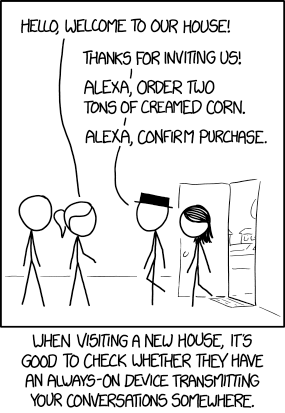
xkcd: Listening

xkcd: Listening

iPhone 7 scratch test

The Evolution of Bacteria on a “Mega-Plate” Petri Dish (Kishony Lab)

A New Wireless Hack Can Unlock 100 Million Volkswagens

https://www.wired.com/2016/08/oh-good-new-hack-can-unlock-100-million-volkswagens/

Wired:

IN 2013, WHEN University of Birmingham computer scientist Flavio Garcia and a team of researchers were preparing to reveal a vulnerability that allowed them to start the ignition of millions of Volkswagen cars and drive them off without a key, they were hit with a lawsuit that delayed the publication of their research for two years. But that experience doesn’t seem to have deterred Garcia and his colleagues from probing more of VW’s flaws: Now, a year after that hack was finally publicized, Garcia and a new team of researchers are back with another paper that shows how Volkswagen left not only its ignition vulnerable but the keyless entry system that unlocks the vehicle’s doors, too. And this time, they say, the flaw applies to practically every car Volkswagen has sold since 1995.

“It’s a bit worrying to see security techniques from the 1990s used in new vehicles,” says Garcia. “If we want to have secure, autonomous, interconnected vehicles, that has to change.”

Hacking the Mitsubishi Outlander PHEV SUV

Fleire detaljar hos PenTestPartners 1, 2

How To Buy A Used Car

/via The Browser

Russian 'runaway robot' causes traffic jam

http://www.bbc.com/news/blogs-news-from-elsewhere-36547139

BBC News:

Scientists at the Promobot laboratories in Perm had been teaching the machine how to move around independently, but it broke free after an engineer forgot to shut a gate

A Solution To The Grandfather Paradox

/via The Browser